
 AeroSim Docs
ABL (Atmospheric Boundary Layer)
The Atmospheric Boundary Layer (ABL) case is the starting point for any wind engineering study in AeroSim. Before simulating wind loads on a building, pedestrian comfort in an urban plaza, or pollutant dispersion across a district, the inlet conditions must faithfully reproduce the target atmospheric flow - the right mean wind profile, turbulence intensities, and length scales. This guided case walks you through setting up and validating a standalone ABL simulation: an empty domain designed purely to verify that what enters at the inlet is what arrives at the region of interest.
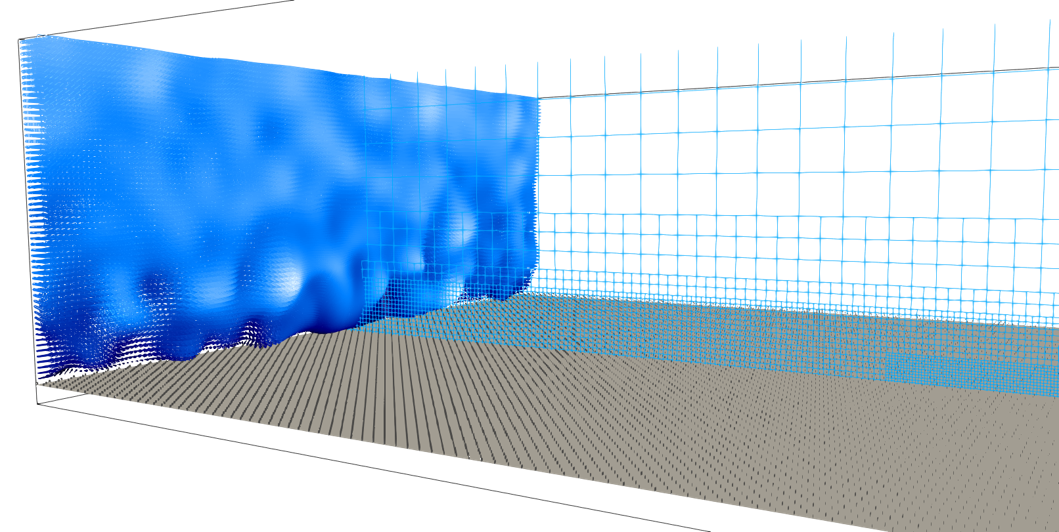
If you are coming from OpenFOAM or Fluent, you are likely familiar with the challenge of maintaining a consistent ABL profile across a long domain - velocity profile and turbulence intensity tend to decay or distort before reaching the building. AeroSim handles this differently through its Lattice Boltzmann Method (LBM) solver, dedicated inlet generation approach and its combination with roughness elements, which simplifies setup considerably while maintaining the fidelity required for engineering decisions.
Background: The Atmospheric Boundary Layer
The ABL is the lowest portion of the troposphere where the wind field is shaped by surface roughness. For most wind engineering applications (buildings, bridges, facades, urban environments), the neutrally stratified ABL is assumed.
The mean wind profile can be modelled by a logarithmic law:
where \(u_*\) is the friction velocity, \(\kappa \approx 0.41\) is the von Kármán constant, and \(z_0\) is the aerodynamic roughness length.
The turbulence structure of the ABL - turbulence intensity \(I_u\) and integral length scale \(L_u\) - is equally critical, particularly when pressure fluctuations on cladding or dynamic wind loads are of interest.
Case Description
The standalone ABL case consists of an empty rectangular domain - no buildings, no obstacles - configured to reproduce a target wind profile at a specified fetch distance. The simulation is validated by checking that:
The mean velocity profile \(U(z)\) at the measurement section matches the target logarithmic law.
The turbulence intensity \(I_u(z)\) is within acceptable bounds of the target.
The profiles are maintained in the region of interest, confirming that the inlet conditions are sustained.
This case is typically run before any geometry is introduced. The validated configuration - roughness settings, domain height, inlet parameters - is then reused directly in the simulation with buildings or terrain.
Before You Begin
Access: AeroSim’s setup interface is available for free at solver.aerosim.io. You can configure the full case - domain, mesh, boundary conditions, and inlet profile - without a license. A license (web or local) is required to run the simulation.