
 AeroSim Docs
Synthetic Eddy Method (SEM)
The Synthetic Eddy Method (SEM) is the standard inlet condition for atmospheric boundary layer and wind engineering simulations in AeroSim. It generates a transient, turbulent velocity field at the inlet that reproduces a prescribed mean velocity profile and Reynolds stress tensor. This allows the simulation to start with realistic turbulence from the first time step, rather than requiring a long domain fetch for turbulence to develop naturally.
See also
For a step-by-step guide on converting wind tunnel measurements into SEM input, see Matching Custom Inlet.
How SEM works
The SEM populates a virtual volume around the inlet plane with \(N\) synthetic eddies at random positions. Each eddy has a Gaussian influence function and random orientation signs. The velocity at the inlet plane (\(x = 0\)) is the sum of the mean profile and the fluctuation contributions from all eddies within range.
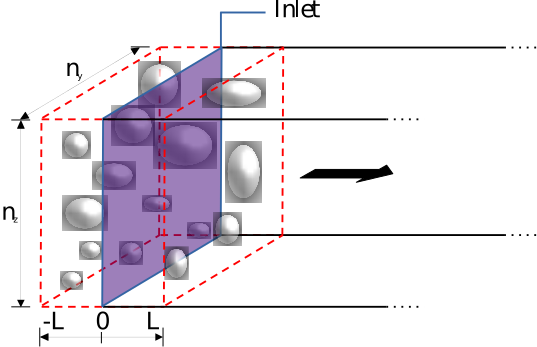
Schematic of the SEM virtual domain. Synthetic eddies (circles) are distributed in a volume of length \(2L\) around the inlet plane. The inlet velocity field is sampled at \(x = 0\).
The velocity fluctuation at any point on the inlet plane is:
where \(\bar{u}_\alpha(z)\) is the prescribed mean velocity profile and \(u'_\alpha\) is the fluctuation field. The fluctuations are constructed so that their time-averaged statistics converge to the target Reynolds stress tensor \(R_{\alpha\beta}(z)\).
The fluctuation velocity is computed as:
where \(A_{\alpha\beta}\) is the Cholesky decomposition of the Reynolds stress tensor (scaled by a tuning factor \(K\)), and \(\tilde{u}_\beta\) is the normalized sum of Gaussian eddy contributions. The Cholesky decomposition ensures that the generated fluctuations produce the correct correlation structure between velocity components.
Eddy evolution
The eddies are advected in the streamwise direction at the domain-averaged mean velocity:
When an eddy exits the virtual volume (\(x_i > L\), where \(L\) is the eddy length scale), it is recycled: its \(y\) and \(z\) positions and orientation signs are randomized, and its \(x\) position wraps back using periodic recycling. This ensures a statistically stationary turbulent field at the inlet throughout the simulation.
Population reconstruction
Once the velocity field on the inlet plane is known, the solver computes the rate-of-strain \(S_{\alpha\beta}\) through a finite-difference scheme and assumes constant density \(\rho = \rho_0\). From these macroscopic quantities, the LBM populations are reconstructed and the subgrid-scale viscosity is computed for the LES model.
Input requirements
The SEM requires two main inputs:
Mean velocity and Reynolds stress profile
A CSV file with the following columns:
z,ux,Rxx,Rxy,Rxz,Ryy,Ryz,Rzz
Column |
Physical quantity |
Notes |
|---|---|---|
|
Height above ground (m) |
Values outside the CSV range are extrapolated as constants |
|
Mean streamwise velocity (m/s) |
Positive in the flow direction |
|
\(\overline{u'u'}\) (m^2/s^2) |
Streamwise normal stress; always positive |
|
\(\overline{u'v'}\) (m^2/s^2) |
Typically zero for neutral ABL |
|
\(\overline{u'w'}\) (m^2/s^2) |
Negative in a standard ABL |
|
\(\overline{v'v'}\) (m^2/s^2) |
Lateral normal stress; always positive |
|
\(\overline{v'w'}\) (m^2/s^2) |
Typically zero for neutral ABL |
|
\(\overline{w'w'}\) (m^2/s^2) |
Vertical normal stress; always positive |
Important
The Reynolds stress tensor at each height must be positive semi-definite. The condition most commonly violated is:
If this constraint is not satisfied, the Cholesky decomposition will fail and the simulation will crash.
This profile data can come from:
Wind tunnel measurements - measured velocity and turbulence intensity profiles, converted to Reynolds stresses. See Matching Custom Inlet for the conversion procedure.
Precursor simulations - a preliminary simulation that reproduces a wind tunnel configuration to generate the mean profile and Reynolds stress tensor for a given terrain category.
Standard profiles - analytical log-law profiles for standard terrain categories, as used in the ABL guided case.
Eddy parameters
The SEM also requires:
Length scale (\(L\)) - the representative eddy radius of influence, specified per direction (\(x\), \(y\), \(z\)). This controls the spatial correlation of the generated turbulence.
Eddy volume density - the number of eddies per unit volume in the virtual domain. Higher density produces smoother statistics but increases computational cost.
Random seed - controls the initial random placement and orientation of eddies. Fixing the seed ensures reproducible results across runs.
Tuning factor (\(K\)) - a scalar multiplier on the Cholesky decomposition that scales the turbulence intensity. The default value of 1.0 produces fluctuations that match the target Reynolds stress tensor.
Practical considerations
Profile consistency with ground roughness
The SEM inlet profile and the ground boundary condition must use the same aerodynamic roughness length \(z_0\). If these values are inconsistent, the velocity profile will drift as it travels downstream and the ground boundary layer adjusts to the actual floor roughness.
Important
Always validate the inlet profile with an empty-domain simulation (no geometry) before running the full case. Extract velocity statistics at the expected model location and compare against the target profile.
Development length
Even with SEM-generated turbulence, the flow needs some distance downstream of the inlet for the turbulent structures to become fully three-dimensional and physically consistent. The development length depends on the flow configuration but is typically on the order of 10-20 eddy length scales.
Reynolds stress derivation
When only \(U(z)\) and \(I_u(z)\) are available from measurements, the full Reynolds stress tensor must be derived using component ratios. The default ratios used in wind engineering are:
\(R_{yy} = 0.5625 \cdot R_{xx}\) (corresponding to \(\sigma_v / \sigma_u \approx 0.75\))
\(R_{zz} = 0.25 \cdot R_{xx}\) (corresponding to \(\sigma_w / \sigma_u \approx 0.50\))
\(R_{xz} = -0.3 \cdot R_{xx}\) (simplified estimate)
\(R_{xy} = R_{yz} = 0\)
For a detailed derivation, see Reynolds Stress Derivation.
See also
Synthetic Eddy Method - Theory - mathematical formulation of the SEM algorithm
Boundary Conditions - overview of all boundary condition types
Matching Custom Inlet - converting wind tunnel data into SEM input
Reynolds Stress Derivation - deriving the full stress tensor from measured turbulence intensity
ABL Guided Case - end-to-end atmospheric boundary layer setup