
 AeroSim Docs
Turbulence
In wind tunnel experiments, most flows occur at Reynolds numbers above \(10^{5}\), hence most wind tunnel simulations are turbulent. Since the smallest turbulence scales cannot be captured, it is more common to perform large eddy simulations (LES), in which the flow large scales are explicitly solved and the small are modeled:
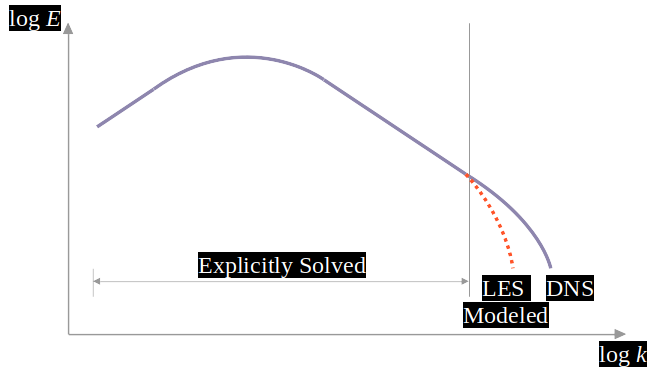
Energy curve
We usually adopt the Smagorinsky subgrid model with constant of 0.17, which is set in the models.LES:
    models:
      LES:
        model: Smagorinsky
        sgs_cte: 0.17
In LES simulations it is possible to export the macroscopic omega_LES which can be used to find the subgrid viscosity \(\nu_{\mathrm{SGS}}\).
Non-Newtonian rheology
Many process fluids (shear-thinning broths, yield-stress pastes, polymer solutions) are not Newtonian: their viscosity depends on the local shear rate. Nassu models this through the generalized-Newtonian framework, in which the apparent viscosity \(\eta(\dot\gamma)\) is a function of the shear-rate magnitude \(\dot\gamma = |S| = \sqrt{2 S_{\alpha\beta} S_{\alpha\beta}}\) (the same strain-rate magnitude the Smagorinsky model uses). The apparent viscosity enters only through the relaxation frequency \(\omega\), so it can be combined with LES; the eddy viscosity is then added on top (\(\nu_{\mathrm{total}} = \nu_{\mathrm{gn}} + \nu_{\mathrm{SGS}}\)). The theory is described in the rheology chapter.
The model is configured through models.rheology. Omitting the block (or model: newtonian) keeps the constant-viscosity Newtonian solver unchanged.
    models:
      rheology:
        model: power_law          # newtonian | power_law | carreau_yasuda | herschel_bulkley
        params:
          K: 0.05                 # consistency index
          n: 0.7                  # flow-behaviour index (< 1 shear-thinning)
          nu_min: 1.0e-4          # stability clip on the kinematic apparent viscosity
          nu_max: 5.0e-1          # (keeps omega inside (0, 2))
The three models and their params:
power_law(\(\eta = K\,\dot\gamma^{\,n-1}\)):K,n,nu_min,nu_max. \(n < 1\) shear-thinning, \(n > 1\) shear-thickening, \(n = 1\) Newtonian.carreau_yasuda(\(\eta = \eta_\infty + (\eta_0 - \eta_\infty)[1 + (\lambda\dot\gamma)^{a}]^{(n-1)/a}\)):eta_0,eta_inf,lambda_,a,n. Inherently bounded between the two plateaus, sonu_min/nu_maxare optional.herschel_bulkley(Papanastasiou-regularized yield stress, \(\eta = K\,\dot\gamma^{\,n-1} + \tau_0(1 - e^{-m\,\dot\gamma})/\dot\gamma\)):K,n,tau_0,m_reg,nu_min,nu_max.
The parameters are given in level-0 lattice units, consistent with the base viscosity from models.LBM.tau. The apparent viscosity is evaluated at the stored (previous-step) strain rate, giving a fully explicit, local per-node update. The stability clip \([\nu_{\min}, \nu_{\max}]\) is mandatory for power_law and herschel_bulkley (their apparent viscosity diverges at a tail) and keeps \(\omega\) inside \((0, 2)\).