
 AeroSim Docs
Free Surface
Free surface BCs are frequently adopted at the top boundary of an atmospheric flow. They can be implemented from a Neumann BC that considers zero gradient of macroscopic properties.
Neumann
The implemented Neumann BC is used to represent a free surface by forcing a zero normal derivative of macroscopics at the boundary:
Where \(A\) represents any macroscopic variable (\(\rho\), \(u_{\alpha}\), \(S_{\alpha\beta}\)). To implement that, the boundary nodes replicate the macroscopic values from the first node towards normal direction.
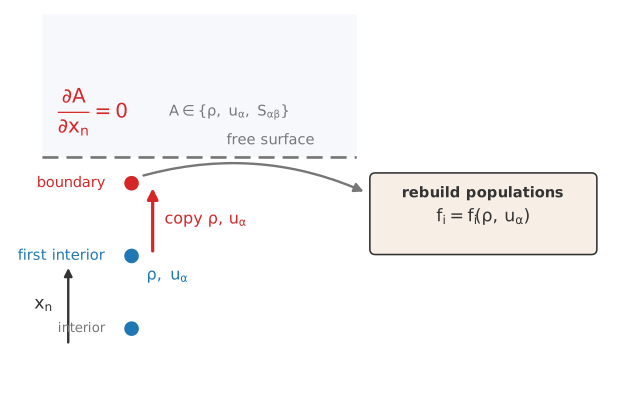
The zero-gradient (Neumann) free-surface condition. The boundary node copies its macroscopic density and velocity from the first interior node along the wall normal, enforcing a zero normal derivative, and its populations are rebuilt from those replicated values.
Use case
A free-surface Neumann BC models the top of an atmospheric boundary layer, where the domain is capped well above the bodies of interest and the flow is left free to slip past without imposing a wall.
Note
Replicating the macroscopics from the neighboring node enforces a zero normal gradient, a stable and fully local approximation of a free surface. It does not model a deforming or two-phase interface; it stands in for one by removing the normal exchange at the top boundary.