
 AeroSim Docs
Couette Flow
Why this case matters
Couette flow is the simplest shear flow with an exact, time-dependent analytical solution, which makes it the first quantitative check a solver should pass. It isolates the response of the collision operator to a pure shear stress, with no pressure gradient and no advection, so any error maps directly to the viscous and boundary-condition behaviour of the LBM. The transient term in (1) exercises momentum diffusion from a no-slip wall, while the steady state in (2) verifies that a moving-wall boundary condition reproduces a linear velocity profile to machine precision. For computational wind engineering this is the building block of every near-wall shear layer, so getting it exactly right is a prerequisite for the more demanding turbulent cases. The reference solution is the classical series expansion reported by Pozrikidis[1].
Couette flow can be defined as a flow between two plates, initially at rest, in which the top plate starts moving with a constant velocity \(U\) while the bottom plate is kept with a null velocity. This configuration is illustrated below:
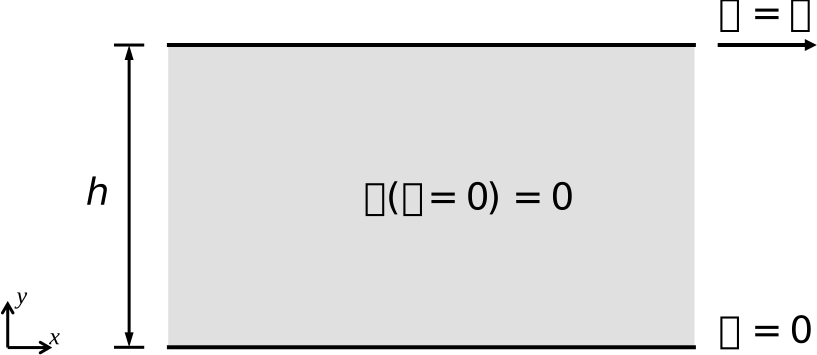
This flow consists of a unidirectional flow with a velocity field that varies only at \(y\)-direction. An analytical solution for it can be found in Pozrikidis[1], and through this solution the velocity can be written as:
After a sufficient time, the flow reaches a steady state Couette flow with a linear velocity profile: