
 AeroSim Docs
Turbulent Pipe Flow
Why this case matters
Turbulent pipe flow is the round-geometry companion to the turbulent channel: a wall-bounded, statistically stationary turbulence whose mean and fluctuation profiles depend only on the friction Reynolds number (2). What it adds over the channel is curvature. Resolving a circular no-slip wall on a Cartesian lattice demands an isotropic velocity set, and this case is where that requirement becomes measurable: Peng et al.[1], the first DNS-grade pipe validation within LBM, showed that the D3Q19 set lacks the isotropy to reproduce the profile and that the D3Q27 set is needed at \(\mathrm{Re}_{\tau} = 180\). For computational wind engineering it certifies that curved bluff bodies and the near-wall shear around them are represented without lattice-induced bias.
The turbulent flow in a pipe is extensively studied in literature and can be used as validation case of turbulence models, wall functions, curved boundaries, among others. As illustrated below, this is a pressure driven flow which can be described periodically using a constant force density.
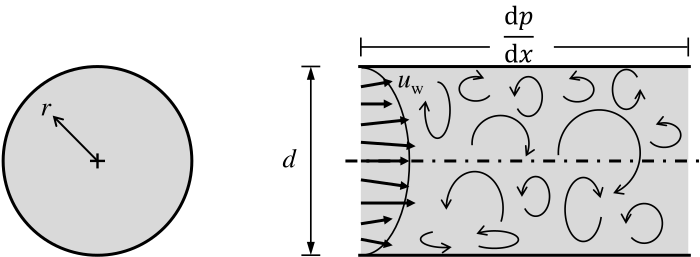
where \(u_{\mathrm{w}}\) is the friction velocity, which is representative of the mean wall shear stress \(\sigma_{\mathrm{W}}\), and is calculated with:
As for the channel, the turbulent pipe flow does present a statistically developed state, to which average and standard deviation velocities are solely dependent on the flow Reynolds number.
The characterization of the flow is usually performed from its friction Reynolds number, given by:
For a turbulent pipe flow, the length scale for calculation of the eddy turnover time is \(l=d/2\).
There are many numerical studies of a turbulent pipe flow available. Peng et al.[1] presents the first DNS validation within LBM. It is shown that the D3Q19 velocity set lacks isotropy to represent a turbulent flow in a circular pipe. The validation is then performed with the D3Q27 velocity set for a friction Reynolds number \(\mathrm{Re}_{\tau}=180\). The average and rms velocity profiles were consistently validated against different DNS studies using spectral and finnite volume methods and are shown below:
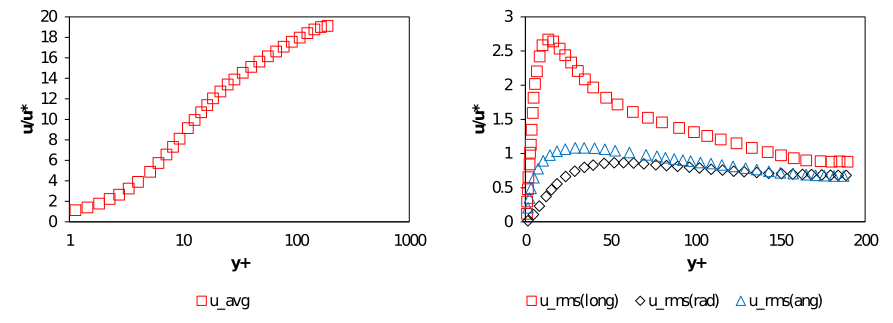
For an accurate DNS, Peng et al.[1] suggests for a uniform grid a sufficient resolution as \(\Delta y^{+} \leq 2.5\). Such scale is suffices the criterion of three grid points inside the viscous sublayer.