
 AeroSim Docs
Flow Through Trees
Why this case matters
Vegetation is not a solid wall: a tree canopy partially blocks the flow, removing momentum and damping turbulent kinetic energy (1) through distributed drag rather than through a no-slip surface. Representing it correctly matters for pedestrian-comfort and urban-microclimate studies, where planting is deliberately used to shelter spaces. This case validates the solver’s porous, drag-based canopy model against the benchmarks of Qi and Ishihara[1] and Kang et al.[2], checking that both the velocity deficit and the turbulent-kinetic-energy profiles downstream of the canopy are reproduced. It extends the solver beyond solid bluff bodies to the distributed obstacles that populate real CWE domains.
The flow’s velocity and turbulent kinetic energy are damped when the fluid pass through tree arrangements. Such situations are common on pedestrian comfort studies. A good benchmark case to test if the solver is capable of representing such tree structures can be found in Qi and Ishihara[1] and Kang et al.[2].
Canopy model
The canopy is represented as a volumetric quadratic (Forchheimer / pressure-decay) momentum sink, not an immersed boundary. On every fluid node inside a predicate region (a cuboid covering the canopy bounding box), a body force
is added to the fluid Guo source term. The region is configured under models.volumetric_regions with a pos predicate over x, y, z and the quadratic coefficient porous_beta (the linear Darcy term porous_alpha is set to zero here). The solver rescales the force per refinement level by \(1/2^{lvl}\).
The quadratic coefficient is derived from the canopy aerodynamics as \(\beta_0 = \tfrac{1}{2}\,C_d\,LAD\), with drag coefficient \(C_d = 1.6\) and leaf area density \(LAD = 1.16\,m^{-1}\), giving \(\beta_0 = 0.928\) in lattice units at level 0. This is a first-principles starting value: the exact equivalent coefficient depends on the lattice-cell normalization, so it is calibrated against the Qi and Ishihara[1] benchmark below.
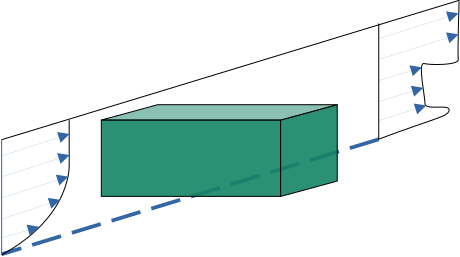
The measurements of flow profile are made for the average velocity and turbulent kinetic energy, which is defined as: