
 AeroSim Docs
Scalar Transport
Nassu can solve the advection-diffusion equation (ADE) for one or more passive scalars \(\phi\) on top of the fluid simulation. Typical applications include temperature in atmospheric and urban-scale flows, pollutant or tracer concentration, and any quantity transported by the resolved velocity field with linear diffusion.
The ADE solved by nassu is
where \(u_\alpha\) is the fluid velocity (read from the LBM step), \(D\) is the molecular diffusivity (with an LES subgrid component when active), and \(S\) is an optional source term.
Method
The scalar is solved with a Double Distribution Function (DDF) lattice Boltzmann scheme: a second set of populations \(g_i\) on a velocity set independent from the fluid lattice evolves under streaming and a recursive regularised collision, recovering the ADE in the macroscopic limit.
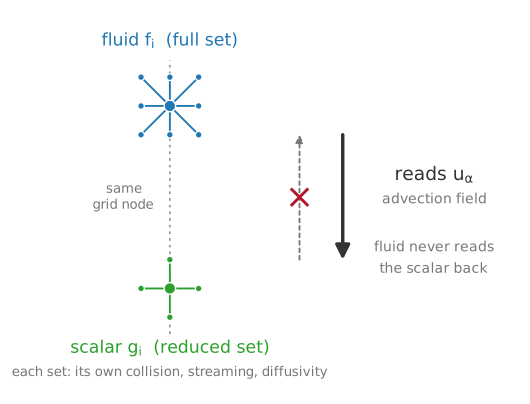
The double distribution function. The scalar rides its own populations \(g_i\) on the same grid as the fluid \(f_i\), with its own collision, streaming and transport coefficient. It reads the fluid velocity \(u_\alpha\) as its advection field; in one-way coupling the fluid does not read the scalar back.
Key idea: the scalar rides its own distribution function
The scalar does not modify the fluid. It carries its own populations \(g_i\) on a separate, smaller lattice and reads the fluid velocity \(u_\alpha\) at each node. This decoupling lets the scalar reuse the fluid’s velocity field while keeping its own diffusivity, sound speed, and boundary treatment independent.
The scalar is decoupled from the fluid (except optionally through Boussinesq buoyancy, see Thermal Extension (Boussinesq)) and reads the fluid velocity at every step:
The pages below cover the velocity set and unit system, the collision and macroscopic state, LES coupling, the Boussinesq path, boundary conditions, solid-body boundaries via voxelization, and integration with multiblock, initialisation, and IBM.