
 AeroSim Docs
Poiseuille Channel Flow
Why this case matters
Pressure-driven channel flow is the laminar counterpart to Couette flow: instead of a moving wall it is driven by a body force or a pressure gradient between two stationary no-slip plates. It is the canonical test for the LBM force term, since the parabolic profile in (1) only emerges if the Guo forcing scheme injects momentum correctly throughout the bulk. The case also confirms that the two no-slip walls and the periodic (or inlet/outlet) treatment combine to give the right mean flow rate, linking the prescribed forcing to the analytical average velocity in (2). In computational wind engineering this validates the machinery that later sustains a turbulent boundary layer against wall friction. The analytical solution is a standard result of viscous flow theory Pozrikidis[1].
Poiseuille periodic flow can be described as a flow between two stationary plates, caused by a pressure gradient \(\mathrm{d}p/\mathrm{d}x\) parallel to the plates. This is illustrated in the figure below.
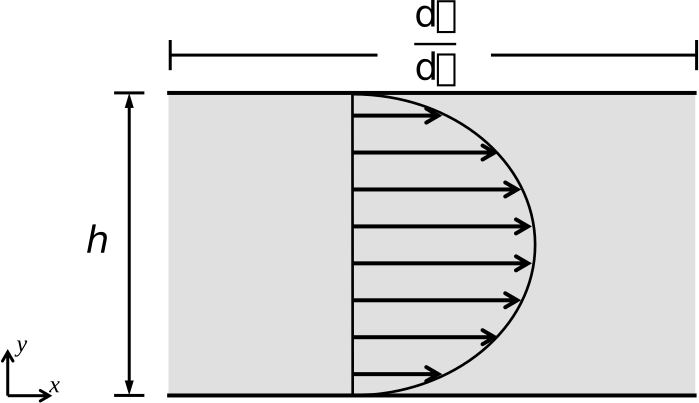
We’re mainly interested in the velocity profile from \(y=0\)[ to :math:`y=1]{.title-ref} (top plate) in the flow direction. This profile is analytically defined by equation (1)
And \(u_{\mathrm{avg}}\) is the average velocity, which can be obtained numerically, calculating its value using the simulation data, or using the analytical equation:
where the pressure gradient can be set through pressure inlet/outlet boundary conditions, or adding a external force to the bulk \(F_{x}=-\mathrm{d}p/\mathrm{d}x\).