
 AeroSim Docs
Poiseuille Pipe Flow
Why this case matters
Pipe flow extends the laminar channel test to a curved, axisymmetric geometry, and is where the staircased representation of a round wall on a Cartesian lattice is first put under pressure. The parabolic profile in (1) has an exact analytical form, so deviations expose how faithfully the boundary conditions reproduce a circular no-slip wall and how much spurious anisotropy the velocity set introduces. Passing it in the laminar regime is a prerequisite for the turbulent pipe case that follows, where lattice isotropy becomes critical. The analytical solution is a classical result of viscous flow theory Pozrikidis[1].
Poiseuille pipe flow can be described as a pressure driven axissimetric flow that occurs in a circular cross-section pipe, as illustrated below.
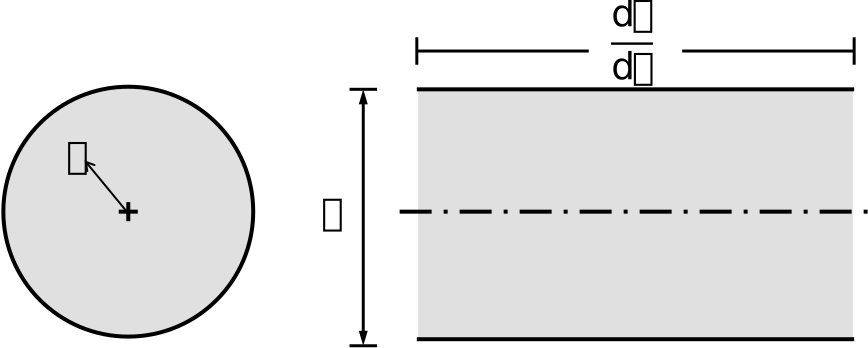
This results in an unidirectional flow to which an analytical solution of the velocity profile with \(0 \leq r \leq 1\) is given by (1)
In which \(u_{\mathrm{avg}}\) is the average velocity that can be obtained numerically, calculating its value using the simulation data, or using the analytical equation:
where the pressure gradient can be set through pressure inlet/outlet boundary conditions, or adding a external force to the bulk \(F_{x}=-\mathrm{d}p/\mathrm{d}x\).