
 AeroSim Docs
Turbulent Flow Over Wall Mounted Cube
Why this case matters
The surface-mounted cube is the simplest geometry that still contains the essential physics of wind flow around a building: a sharp-edged bluff body immersed in a turbulent boundary layer, with windward stagnation, fixed-edge separation, a horseshoe vortex wrapping its base and a large recirculating wake. It is the standard stepping stone between canonical flows and full CWE geometry. The mean and fluctuating pressure coefficients (2) and the wake structure are well documented in wind-tunnel experiments Martinuzzi and Tropea[1], Meinders et al.[2], LIM et al.[3], Lim and Ohba[4], Curley et al.[5], so the case validates that the combined inflow turbulence, wall treatment and immersed boundary method reproduce the wind loads on a building shape at the Reynolds number (1).
The problem of a turbulent flow around a surface-mounted cube is a study case of great interest since it can be seen as a simplified setup for a building under wind loads. The phenomenon is described as a turbulent flow around a cube placed on a wall, to which a turbulent boundary layer velocity velocity is found sufficiently far from the cube. As illustrated below:
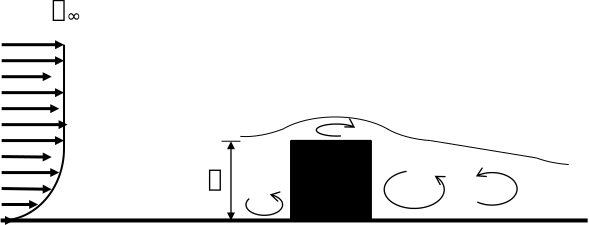
The flow behavior is dependent from the flow Reynolds number, which for this case is defined as:
The pressure coefficient \(C_{p}\) around the sphere surface is calculated from the local pressure \(p\) as:
where \(p_{\infty}\), \(\rho_{\infty}\), and \(U_{\infty}\) are the free stream fluid’s pressure, density, and velocity, respectively. It is also important to check the pressure coefficient calculated from the root mean squared pressure to check flow statistics, which is given by:
Another parameter frequently used for validation of flow around a sphere is the drag coefficient, which is Reynolds dependent and is calculated as:
where \(F_{\mathrm{D}}\) is the drag force exerted by the fluid on sphere surface, and \(A_{\perp}\) is solid body area perpendicular to the flow direction, which in the present case is the area of a square of side \(d\).
Wind tunnel data of this kind of flow is available in the studies from Curley et al.[5], LIM et al.[3], Lim and Ohba[4], Martinuzzi and Tropea[1], Meinders et al.[2].