
 AeroSim Docs
Lid-Driven Cavity
Why this case matters
The lid-driven cavity is the canonical benchmark for validating moment-based boundary conditions in the lattice Boltzmann method Mohammed and Reis[1]. A square cavity with three stationary no-slip walls and a single moving lid produces a recirculating primary vortex plus secondary corner vortices whose strength and structure depend only on the Reynolds number, so the centreline velocity profiles are a sharp, geometry-free test of the wall treatment. It is the natural validation for the moment-based wall closure introduced in the boundary-condition rework (see Moment-Based Boundary Conditions): the lid is the moment-based moving wall RegularizedVelocityWall, and the three static walls are the no-slip RegularizedHWBB, which is the zero-velocity case of the same closure. No population bounce-back is used. Because the corner singularities at the lid make this a demanding wall test, reproducing the benchmark profiles confirms that imposing the hydrodynamic moments at the boundary captures both the bulk vortex and the near-wall behaviour.
The accepted reference is the high-accuracy multigrid Navier-Stokes solution of Ghia et al.[2].
Setup
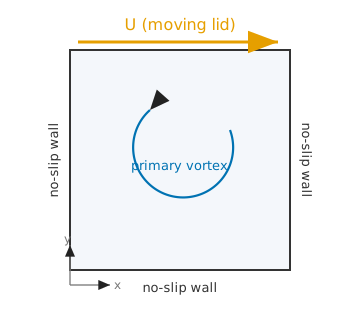
A square cavity of side \(L\) (2-D, D2Q9 lattice) is filled with fluid initially at rest. The top wall (the lid) translates in the \(+x\) direction at a constant speed \(U\); the bottom and the two side walls are stationary no-slip walls.
The Reynolds number is
It is swept over \(\mathrm{Re} \in \{100, 400, 1000\}\) at fixed grid (\(L = 256\)) and fixed lid speed (\(U = 0.05\), so \(\mathrm{Ma} = U\sqrt{3} \approx 0.087 < 0.1\)), varying only the viscosity through \(\tau = 3\nu + \tfrac{1}{2}\).
Reference solution
There is no closed form. The benchmark is the tabulated solution of Ghia et al.[2], given as two centreline profiles:
the streamwise velocity \(u(y)\) along the vertical centreline \(x = L/2\), and
the vertical velocity \(v(x)\) along the horizontal centreline \(y = L/2\),
both normalised by the lid speed \(U\). The digitised tables (Re = 100, 400, 1000) are committed under reference/ with their provenance in reference/REFERENCES.md.
Simulation parameters
Parameter |
Value |
|---|---|
Lattice |
D2Q9, RR-BGK |
Cavity side \(L\) |
256 |
Lid speed \(U\) |
0.05 |
Reynolds numbers |
100, 400, 1000 ( |
Relaxation time \(\tau\) |
0.8840 / 0.5960 / 0.5384 |
Lid BC |
|
Side / bottom BC |
|
Steps to steady state |
300k / 500k / 800k |
Validation metrics
At steady state the simulated centreline profiles \(u(y)\) at \(x = L/2\) and \(v(x)\) at \(y = L/2\) are compared against the Ghia tables at each Reynolds number. Success criteria: the profiles overlay the benchmark points (including the sign reversals of the primary vortex and the near-wall extrema), and the mean absolute deviation from the tabulated points stays within about one percent of the lid speed across Re = 100-1000. The wall density is taken zero-normal-gradient from the interior (the default for the moment-based walls); pinning it to a uniform constant instead would impose a spurious uniform wall pressure and roughly quintuple the deviation at Re = 1000, since the cavity wall pressure genuinely varies.